Transcript
Dave: Susie, Claudine. How are you?
Suzie: Hi. Great. How are you?
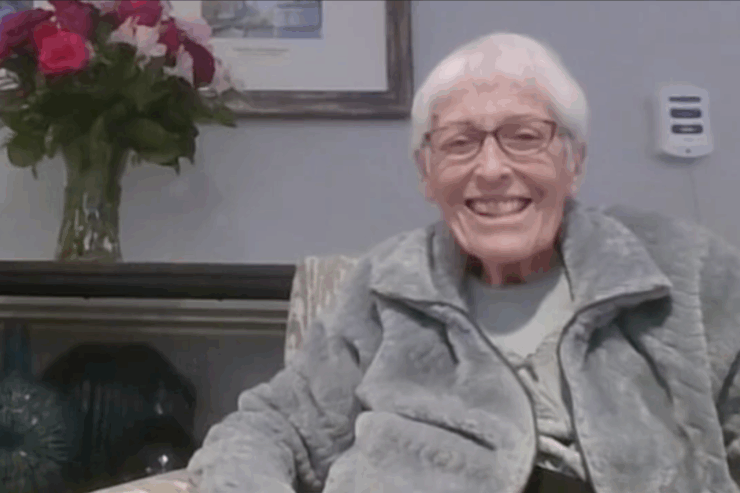
Dave: Good. I’m glad that you got those beautiful flowers that I sent you.
Claudine: You notice those back there?
Suzie: No. I didn’t. Thank you.
Dave: So, Susie, you live at Cogir Of Edmonds in Washington. You picked a beautiful place, Susie. Why Washington?
Suzie: I moved to Washington after graduate school and, because I went to University of Washington graduate school in Seattle. Then I moved to Olympia a couple of times. I moved to Edmonds. Not now. Then I moved to Everett. I worked in Edvard with my working nurse. I drove with my working nurse. Yep.
Dave: And Claudine, you’re a, friend of Susie.
Susie: She is a very good friend of mine. She and her husband have been helping me a great deal.
Claudine: We’ve been friends for a long time. Yeah. Since the 1990s, my husband Doug and I moved here from New Mexico, and Susie was our first friend and neighbor, three houses down. Thanks.
Dave: Oh, isn’t that great? And now you get to visit Susie and continue your awesome friendship at Cogir.
Claudine: Yes. Exactly. I enjoy visiting her here very much.
Dave: And then Edmonds, I wanna say, North Of Seattle. Correct?
Claudine: Right. Yes.
Dave: On the beautiful sound. So, Susie, tell me about you because from what I understand, and I haven’t had a chance to meet you yet, you are enjoying one incredible life and you’ve been involved in so many different things. Susie, tell me more about you.
Susie: Most of my life, I’ve been involved in barbell things, as a member of the Piltocharau Island, which is in Stokeshree. And I grew up in California in Palo Alto because my dad went to Stanford and came out of the military. So I’m a World War two baby. And, and I lived there, grew up and went to school there. And then, then I left and I left California. And I lived in San Francisco, San Francisco for a brief time. And I got my bachelor’s degree at San Francisco State in acting. I have a degree in drama. Then I went to the University of Washington to put the school of social work in Denver at the University of Washington.
Dave: So you are a Washington Husky through and through. And you’ve stayed in the Washington area your entire life?
Suzie: I stayed here because I got a job at DSHS.
Dave: So were you looking at being an actress? Is that what drama school was all about?
Suzie: That’s– that’s what I thought I was gonna do. And I’ve never made very much more money acting, I’ll tell you.
Dave: And life takes crazy turns. And Claudine being Susie’s friend, I’ve heard how involved Susie has been in the community. Talk about that.
Susie: I’ve always got very involved in whatever I do, particularly if it’s you know, I help people in some way. Some people, some people in some ways. And, for example I have worked for DSHS, which is the Department of Social Social Analysis Services for the State of Washington. And, I was the Regional Administrator, Everett for developmental disabilities for my working life, wasn’t my working life. Long story about how I got to go working there from going to graduate school. But I went to graduate school in Washington at Seattle, and I got interested in the field of community organization. And so, I basically learned everything I’ve used as an adult. I learned in graduate school how to organize people to community organization. And, my degree in social work isn’t about counseling or anything like that. I’m a lousy counselor. But, I’m, I’m, I’m, I could organize anything. And I did. So, it was, first of the rest of my life since particularly, particularly since I moved here.
Dave: Susie, it sounds like you’ve enjoyed a life and still continue to enjoy a life of helping others.
Suzie: It’s been interesting. I’ve done and I’ve done quite a few interesting things. I’ve lived all over the world, through– I can’t get very involved in one thing at a time. Mostly one thing sequentially. I got involved with Earthwatch, which is an environmental organization. And I’ve worked on Earthwatch projects all over the world. So for my own fun, I volunteered and paid for to go to different places in the world working on environmental projects.
Dave: Really? Like, what were some of the interesting places that you traveled to as a volunteer?
Suzie: Well, the last place I went to was in Columbia, South America. And, which changed my life entirely because I met my family down there. And they’ve all lived in my house and I’m part of that, part of that family. Happened for many, many, many, many years. And I was also in Cameroon, Cameroon, working on a project in Cameroon, Africa. Before that, I was working on a place in Israel.
Dave: Israel. Susie, you’ve been everywhere.
Susie: Yeah. So I’ve been to interesting places. I chose them because Earthwatch had projects that had them. And I paid good money to be in their projects, and I did research. So I spent a lot of my adult life doing that for fun. That’s my idea of fun.
Dave: Oh, well, it sounds fascinating, and I can see how that would be fun.
Susie: It was. So living in other parts of the world, and I’m glad I did. I’m glad I did. Up until I graduated my school, I never been anywhere but for how how a while ago.
Dave: And you mentioned that you were a war baby.
Susie: So I was born in 1940.
Dave: You were probably old enough to remember, maybe, some of the ships, maybe post World War two coming in and out of the Bay Area. Correct?
Susie: Yes. Well, one of them brought my father-in-law because he was in North Africa in the navy. I lived with them. I grew up there. And I remember going on my ship as a child. Don’t drink too much soup because it cooks too much pepper in it.
Dave: Okay. Do you remember what ship your father was on, the name of it?
Susie: Yellow Harrow.
Dave: You know, the navy just being a history fan, Susie, the reason I asked, the navy was so instrumental in Northern Africa. And everybody talks about, you know, general Patton and the army going into North Africa, and it’s true. They were incredible as well. But the navy is the one that secured the perimeter and supplied all of those troops. And it was a dangerous mission in those days because the Germans and others knew that if they cut off that supply to the American troops, we’d be in trouble. So your father wow.
Susie: That’s– The supply officer for the ship.
Dave: Susie, I’m sure your father told you, but during World War two in that time, that’s when those u boats from Germany would patrol the Atlantic and areas trying to keep supplies from going into North Africa. Your father must have had some incredible stories.
Susie: But like many fathers, they didn’t have. I don’t know how I don’t have any war stories. Lots of stories from everything else I’ve done, but I don’t remember my father talking about the war, sir, the war. He didn’t want to talk about the war.
Dave: World War two, that was pretty common. They didn’t really talk about it quite as much. So I have to ask you, Susie, why Washington? Why didn’t you stay in Duke? I mean, you have Stanford right there. You have, you know, University of California, Berkeley right there in the Bay Area, San Jose State. There’s a ton of colleges in that area.
Susie: My bachelor’s at San Francisco State.
Dave: Yep. San Francisco State. So why did you go to Washington after that?
Susie: I came to Washington to go to graduate school in social work. By then, I got interested in helping people, I think, and then organizing and then organizing things.
Dave: Do you enjoy public speaking?
Susie: Well, I’m not shy. I’m not a shy person.
Dave: Susie, tell me about Cogir of Edmonds. Why is it special to you?
Susie: I have been here since I got out of the hospital. One of my old roommates’ mother, right, she was Yassie’s mother, lived here and so at Cogir in Edmonds. And so they found this place. They called me and they said they told me I was coming to Cogir. Cogir.
Dave: And Claudine, when you visit your friend Susie at Cogir, I know that they have so many activities. What do you guys do together? Do you watch movies together? Do you play games together? Do you eat in the dining room together? What do you do?
Susie: Stephanie brings in wonderful programs and wonderful people to play and make music for us. Because it that’s, music has always been anchors of mine and she brings in all these wonderful people and they sing in her by the piano for us and I oh, I haven’t missed any programs that I think that she’s had been for since I’ve been here. So I’ve been here since
Claudine: August,
Susie: I think. Okay. I think she came in August.
Dave: What’s your favorite food there in the dining room? What do they make for you?
Susie: Lots of good stuff.
Claudine: But fish? You like the fish?
Susie: I like fish. Yeah. I really like fish. We had a wonderful Christmas dinner. Wonderful Christmas dinner.
Dave: Well, Susie, if you live on Puget Sound and you don’t like fish, that would be a problem.
Susie: That would be a problem. I do like fish.
Dave: Well, hey. It’s wonderful talking to you, and I’m glad that you received the flowers that I sent you. Claudine, thank you for pointing those out.
Claudine: You’re welcome. Beautiful. Hard to miss.
Dave: And my best to both of you. Okay? Thank you.
Summary
Susie, a resident at Cogir of Edmonds in Washington, shares her fascinating journey from growing up in Palo Alto, California, to a life of global travel, public service, and community involvement. With degrees in drama and social work, Susie combined creativity with purpose, spending her career organizing programs and advocating for individuals with developmental disabilities.
Her love for adventure and helping others led her to volunteer with Earthwatch, participating in environmental projects around the world—from Colombia to Cameroon. She speaks about the importance of connection, learning, and staying active, both mentally and socially.
Now living at Cogir of Edmonds, Susie enjoys the welcoming environment, music programs, and quality dining—with fish being a favorite. With longtime friend Claudine by her side, Susie continues to live a life full of purpose and friendship in a community that supports her well-being and passion for learning.
Liked what you read?
Spread the word!
Share
Related News
Senior stories by Cogir: John and Mary
Transcript Dave: Hi, John. Cogir Rancho Cucamonga. Right? John: That’s correct. Yes. Dave: Did I pronounce that right? John: Yes. The only time it’s mispronounced is if you have a British…

Cogir of South Bay celebrates grand opening
TORRANCE, Calif. (Oct. 21, 2024) – Ryan Companies US, Inc., a national commercial real estate solutions provider, and Cogir Senior Living announce today the grand opening of Cogir of South Bay. The resort-style…

Thrive at every age: the benefits of active senior programs
Staying active is vital to longevity. Simple activities and exercises can boost physical and mental health, helping us feel good inside and out. But it can be hard to start and keep up a new habit, especially…