Transcript
Dave: What a life. What a journey. This man grew up on the West Coast and the East Coast in America’s biggest cities, the Peace Corps. How about being in the Bay Area during the summer of love and the psychedelic era with the Grateful Dead and Jefferson Airplane and the start of Hendricks and Bill Graham’s Fillmore and Winterland? And then, oh, how about being a war photographer in one of those bubble helicopters hanging out the side? Yeah. Today, you’re gonna meet John McKay at our Cogir Community on Napa Road in beautiful Napa Valley.
Dave: Hi, John.
John: Hi there.
Dave: Well, all I know is that I just talked to one of your fellow residents at Cogir Napa Road, and she was drinking a wine, And now you have a mug of beer. I think I wanna be there.
John: You do wanna be here. Where are you?
Dave: Phoenix, Arizona.
John: Oh, you wanna be here.
Dave: Is that where you’re from, John? Are you from Northern California?
John: I was born in Seattle, but moved down to the Bay Area after three years and lived in Boston, moved to New York three years each, in those young kid ages. And then back to the Bay Area to North San Francisco, which would be just south of here for seventh grade through college.
Dave: So being from the Northwest, Seattle and San Francisco, what put you in the Northeast, in Boston, and New York?
John: My father was in management with an insurance corporation. So every three years, he was fortunate to be promoted or either move and get promoted or find another job, maybe. However, that took us to the head offices in or let me say, the head office is in San Francisco, but running the office in New York and then running the New York– the Boston office and then back to San Francisco.
Dave: So John, what was that like as a kid? Was it fun bouncing around, or was it tough because you had to make new friends everywhere and new schools?
John: It was hard each time, but each time became more understandable. However, by hitting Boston, my mother had come down with severe cancer. And so from grade school on until I entered college, she was battling cancer. So very difficult for my father. He’s climbing the proverbial ladder. He has three sons. He has a terrific wife who is dying of cancer. And it’s so the family dynamics get very intense.
Dave: So you have two brothers, and–
John: Yes.
Dave: Were you raised close?
John: Very close. Love my brothers. One was working with the Clinton administration and FEMA, and he had a heart attack and he passed away. So he died at 50. My younger brother is still alive. He’s a rock and roll and jazz musician in Muscle Shoals, Alabama.
Dave: Wow.
John: And he’s married to a legendary singer herself in the Rock And Roll Hall Of Fame. So
Dave: Who is that?
John: They have a family of musicians.
Dave: Who is the member of the rock and roll hall of fame that he’s married to?
John: Donna Jean sang and recorded with lots of people. But Percy Sludge, When a Man Loves a Woman
Dave: Of course.
John: Elvis Presley and his comeback in his, In the Ghetto and Suspicious Minds. And, and then she joined the Grateful Dead out here in California, and she was, in the dead for, through the seventies. And my brother was a bass player out here. And so her husband died as do all the piano players in the Grateful Dead. And so she married my brother, and then they moved to Alabama, which is if you ever get a chance to watch a Netflix program called Muscle Shoals, it’ll show you the really the home of lots of, legendary rhythm and blues, Aretha Franklin, Allman Brothers, Lynyrd Skynyrd, etcetera, etcetera. Bob Dylan, Rolling Stones, they all recorded in Muscle Shoals.
Dave: Boy, during that era too with–
John: Yeah.
Dave: All of those artists, the Grateful Dead in the sixties and seventies in the Bay Area. Oh my goodness.
John: And I used to do light shows with them. When I was in college, I learned about the light shows that Bill Graham was doing in San Francisco.
Dave: At Winterland.
John: At Winterland, exactly in the Fillmore. And I called Bill Graham up, and I go, I’m nobody. But my friends have told me what you’re doing, and I wanna learn. So he said, come on over. I met him at 2:00 at Entrance Of Winterland, and he met me and brought me in and explained how to put a show on and took me up to the light show, the director who does all the liquid art. And that’s what– I’m an artist, and I’m interested in that part. So I came back that evening, and they showed me the full production. And I started my own company up in the Puget Sound area.
Dave: John, did you realize during that time because you’re talking legendary–
John: Sixty five, sixty six.
Dave: We’re talking I mean, the Grateful Dead, but the whole–
John: Yeah.
Dave: Psychedelic era, Winterland, Bill Graham. Those days, the early Jefferson Starship, Hendrix, Arlo Guthrie, the folk singers, everything happening on the San Francisco scene, you were right in the middle of it. Did you realize it at that time that you were in the thick of something special?
John: Yes. But it was no big deal. It was our people doing that stuff. My, you know, my brother was making music. I had adult parents who were lawyers to Grateful Dead, and they were ACLU lawyers. So when the docs were rioting, they were–
Dave: Yeah.
John: Part of, working with Harry Bridges and the Longshore Union. So these were real activists in the thirties and the forties and raising us. So, it didn’t mean my father was out there, as a union, but because he was in corporation, but other parents in Marin County were part of that.
Dave: Unbelievable era.
John: And there was Alan Watts who was talking about Zen Buddhism. He was living with Jean Varda, who was a painter friend of mine, but also a friend of Picasso and George Brock. And so we have this beatnik, and more ancient society around us. There were– I mean, all I can say is yes. In San Francisco, you know, you’re right in it.
Dave: Oh, in that era too, seeing so many of the ships and not just the cargo ships, but the warships
John: Right.
Dave: Coming in and out of the Bay Area underneath the Golden Gate Bridge in Sausalito, of course, right there. That had to be a fascinating time. And you were a war photographer. Correct?
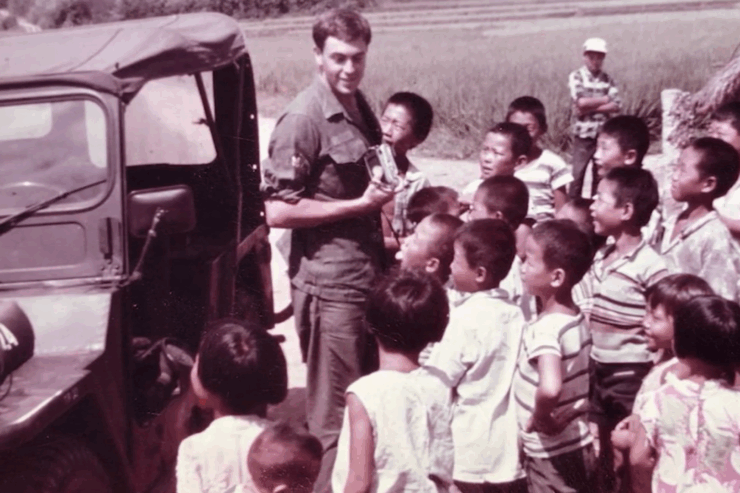
John: I was a photographer during the Vietnam War. I was in Korea. I was very much a war photographer, but I was in Korea. So what I did was, I mean, there were a lot of neat, interesting jobs, but it was not under fierce combat. I was in Korea during the Vietnam era.
Dave: Right. But the overall environment was so explosive, you had to see some unbelievable things. Interesting fall over in Korea
John: I did. I followed, I filmed the DMZ and little bubble helicopters. And anytime there were troop movements, that film would just go right to the Pentagon.
Dave: The bubble helicopter is the ones that didn’t have the doors on them?
John: They didn’t have doors on them. Some had doors on them.
Dave: So you were leaning out as a photographer?
John: Yes.
Dave: John, come on.
John: I’d say, where’s my parachute? And they’d say, I’m sorry, Mac. We’re flying too low. You don’t get a parachute.
Dave: Do you ever get used to something like that? Did you get shot at?
John: When we got shot at, I was the one who told the pilot, the officer pilot, let’s get the hell out of here. Yes. But it was not common.
Dave: You see, John, I would have told the pilot, let’s get the hell out of here before you even took off.
John: Well, it was my job. I spent a lot of time up on the DMZ up at Panmunjom because when I first got to Korea, well, there were two different occasions. But while I was there, the spy ship Pueblo was captured, And there were a hundred soldiers on that spy ship, our ship, Pueblo, captured by the North Koreans. So one of my assignments was to go up to Panmunjom on the border and film the negotiations between the red Chinese, the North Koreans, and the United Nations, commanding general, who was a four star general named General Bonestill.
Dave: Well, that was a powder keg waiting to happen, wasn’t it?
John: Probably today is a bigger powder keg, frankly.
Dave: And when John, for our viewers, when John mentions the DMZ, that’s the military zone John: Yeah
Dave: That had to be unbelievable to be flying over. With some of the subject that you had to shoot being a war photographer, Do you ever get used to that, John? Do you ever become accustomed to that?
John: Frankly, I was good at it.
Dave: Nev–. Never stuck with you? Never bothered you? Never got in your head?
John: No. Yeah. I was very fortunate. I mean, don’t get me wrong at all. I was very fortunate. I mean, I was there when Bob Hope and beautiful ladies would come, and I’d be given the front row to film. And my officers in charge would just ask for whatever I can capture on film they won.
Dave: So that was pretty nice. You had Ann Margret and Mitzi Gaynor and I had Ann Margret.
JohnL You’re absolutely right. Gold star, what, the gold diggers from, Dean Martin show.
Dave: Those are pretty good days for sure. John, tell us about living at Cogir, Napa Road, Napa Valley.
John: I was, I’ve lived in Sonoma for fifty plus years, married, and recently, my wife passed away. And I got pretty sick on my own and moved to a hospital. And my daughter found this as what she considered to be the best option for me leaving the hospital, and I just stepped right into it.
Dave: You’ve made friends? Do you enjoy living in the Cogir community?
John: Yeah. I mean, my very first day, I was saying goodbye to someone who brought me here, and they were having a Zumba class– Zumba downstairs. And I just go, okay. See you later. And I just joined the class. And it’s been that way ever since. I have been fortunate to be able to take advantage of a lot of the activities here, and I appreciate that immensely. And that’s been part of my resurrection. Part of me– from surgeries, I have a number of, I will call them disabilities. So I need a lot of work to get over those. Everything is internal. So I look too good here. I’m sure people go, what are you doing here? But I just have to ride that out. And, we have a gymnasium, and I’m able to do some exercises there. We have an art craft room, and I love to do art. And so I like to be down in that room and encourage others to jump in, and they do. So it’s fun to play a couple of roles. I just left a bridge game. So I like to play bridge as often as possible. And it’s, you know, all these activities just blend in beautifully to keep all your keep your mind working, and so I’m very happy.
Dave: And you’re also great for the community, John, because you have so many wonderful stories. I mean, from growing up on the West Coast and the East Coast in America’s biggest cities to being in the city of love during the psychedelic era
John: Yeah.
Dave: And working at Winterland And Fillmore with Bill Graham, seeing that whole era, and then being a war photographer in one of those bubble helicopters. You’re an interesting guy, John. You’ve had an interesting life, and I’m glad that you’re still enjoying it.
John: Thank you.
Dave: My pleasure, John. Thank you. Terrific. Really enjoyed it.
Summary
John McKay, a resident at Cogir of Sonoma Plaza in the heart of Napa Valley, reflects on an extraordinary life. From growing up in major U.S. cities to experiencing the Summer of Love in San Francisco, working alongside the Grateful Dead and Bill Graham, and serving as a war photographer during the Vietnam era, John’s journey is anything but ordinary. Now enjoying art, bridge, and community life at Cogir, he continues to live fully, surrounded by stories, creativity, and connection.
Liked what you read?
Spread the word!
Share
Related News

Boutique, luxury senior living
Luxury, boutique living reflects a growing shift in how older adults and families think about care, comfort, and daily experience. While the senior living industry offers a wide range of wonderful options…

Why private pay senior living offers more value than you think
Listen here Many families begin their search assuming private-pay senior living is too expensive. That reaction is common, especially when you are comparing options or researching the cost of senior…

Heartfelt holidays: Easy recipes for seniors, lasting memories
With the holidays right around the corner, there can be a lot to prepare for. Whether it’s shopping for presents, decorating the house, or deciding whose house to go to for what, there is always something…