Summary
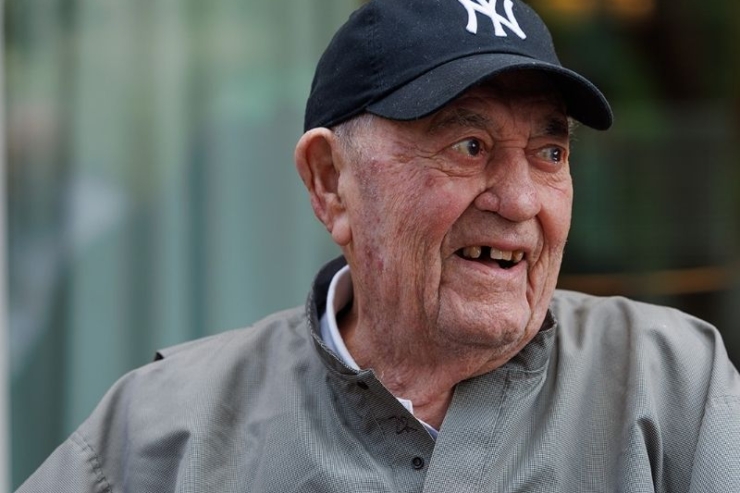
Art Schallock, the oldest living Major League Baseball player, recently celebrated his 100th birthday at Cogir of Sonoma Plaza in Sonoma, California. In this conversation, Art reflects on his time serving in the Navy during World War II, his professional baseball career with the Yankees, and memories of playing alongside legends like Yogi Berra and Mickey Mantle. Art shares stories from a life well lived—including his love for baseball, golf, and his 75-year marriage.
Transcript
Dave: Major League Baseball’s oldest living player. Yeah. He just turned 100 years old. How about that? Art Shallock lives in one of our beautiful communities. Art lives at Cogir on Napa Road in Sonoma, California. Oh, he’s got his Yankees hat on. Hi, Art. How are you doing?
Art: Okay.
Dave: What an incredible life. How have you been celebrating 100 years?
Art: Well, I have an interview every day at two. Drinking a beer now and then. You know, I’ve been very happy, very fortunate living this long.
Dave: One hundred years. Congratulations.
Art: And four months.
Dave: And four months! So you were born and raised in California. Where’s your hometown at?
Art: Mill Valley.
Dave: And is that Sonoma County?
Art: That’s Marin County
Dave: So how far from Sonoma?
Art: Well, it was Sausalito, and then it was Mill Valley and San Rafael and Movado and what have you. But I was born and raised in Mill Valley.
Dave: So born in 1924, was the Golden Gate Bridge even under construction yet at that point?
Art: Well, it was under when I was a kid in grammar school, it was under construction. They were building the highway to the bridge. They hadn’t finished the bridge yet. I was one of the first ones across the thing in ’36.
Dave: So you’re 12 years old. And I’m just thinking here, Art, in the early 1940s, you were a young man coming into age.
Art: I was in high school.
Dave: And World War two is just starting to ramp up.
Art: I was in the Navy. They told me to sign up for the CG, which is in the Coast Guard.They needed a left handed pitcher over there. Anyway, I got the paper that said CG, Coast Guard, and filled it out and stuff. Then they called 20 names out, and I was one of them and I was being sworn into the Navy.
Dave: Well, that San Francisco area too with the Navy during that period of time, just naval ships coming in and out like crazy. Right?
Art: Aircraft carrier as a radar operator for three years. It was the USS Coral Sea, and halfway through the war, they took the name away from us because they were building a big aircraft carrier, and they were gonna name it The Coral Sea, and they gave us the name Anzio.
Dave: USS Anzio.
Art: Which was built by Kaiser. He used to build the Liberty ships up in Seattle when they converted them into aircraft carriers. And they used to call them CVS, carrier vessel escort.It was out in the Pacific during World War II.
Dave: And you participated in Okinawa and Iwo Jima?
Art: I was there all about in the Pacific when we started our offense. So it got torpedoed by the Japs, and it went down in about twenty minutes. Thirty five hundred people.
Dave: The escort ship on your carrier went down by a torpedo?
Art: Yes. I forget the name of it. It was the third carrier that Kaiser built. We used to call them Kaiser coffins.
Dave: And a radio operator. Tell us about that, Art.
Art: There were about 12 of us who were radar operators, but my job during the war, you know, where the captain is on that island, I was above the captain – way up there in the crow’s nest, they called it. They had a clipboard, a stopwatch, and they used to turn in the planes when they took off and landed and stuff. The captain wanted to know that. The only trouble was when the kamikaze came along, I was scared to hell.Those guys coming down at us with the planes. But we had some good shooters – hitting the 20 millimeters, knocking them down before they hit us. When I got out of boot camp, I went to Seattle, and there was a guy up there that wanted a left handed pitcher on his team up there. The next day, my name was on the bulletin board – report to San Diego for radar school.
Dave: All this because they wanted a pitcher. They wanted a good left hand pitcher?
Art: Yeah. They wanted a left handed pitcher. I was very fortunate in getting far as I did in baseball because of my size. I’m just a little guy. Most of our old pitchers are all six foot and a little taller. The thing I did notice on Bob Feller and Sandy Koufax – those guys had huge hands – huge!
Dave: So, Art, let’s talk some baseball here as a left handed pitcher, not above six feet. What was your big pitch? Was it a breaking ball, a curveball?
Art: I had a big curve, and I had a sneaky fastball. I was sneaky. The best pitch I came up with later on was a change of pace – throwing it the same motion as a fastball. But it just floated in there.
Dave: Well, it worked for you. For sure. After the Navy, you were actually with the Dodgers before the Yankees. Correct?
Art: Yeah. I signed with the Dodgers. In my first year was with Walt Austin and Class-A Ball, and I played in Pueblo, Colorado, Class A. Then I went then I went to Montreal and damned if Montreal didn’t win the pennant and Little World Series. The first baseman was Chuck Connors. Then I found out that Brooklyn had a working agreement with Hollywood. The Pacific Coast League would rather me take the car and the two kids and drive all the way back to Vero Beach for spring training. They traded me from Montreal to Hollywood for a buck. I still belong to Brooklyn. I was pitching one day against Portland, not knowing that the head scout for the Yankees, Joe Devine, was in the stands scouting me, and I didn’t know that until after the ball game. Fred Haney, who is the manager of Hollywood, called my wife out of the stand. He said,” I just sold Art to the New York Yankees.” You know what my wife said? She said, “Who in the hell are the New York Yankees?” Fred Haney just fell out of the chair laughing. Anyway, it worked out and gave him my buddy to go to Hollywood. The first year, they won the pennant in the Little World Series in the Pacific Coast League, so I was very fortunate in being on the right team at the right time.
Dave: And the Yankees – three world championships you won with the Yankees. Correct?
Art: ‘51,’52, ‘53. The one in ’53, it was a numeral five and the diamond was set in the circle part. My wife hid the thing so well in the house, she forgot where she put it. When we moved, I think it went to the dumps.
Dave: I hope you’re joking.
Art: No. I’m not. Oh. The ring is gone. It’s in the dumps someplace.
Dave: Oh my. Art, talk about your teammates, a lot of famous teammates on the Yankees.
Art: Well, probably the guy that I like most of anything else was Bobby Brown. I don’t know if you knew Bobby Brown.He was a third baseman. He was from Galileo High School in San Francisco. He got straight A’s through Galileo, straight A’s through Stanford, and then he became a brain surgeon after baseball. A wonderful brain surgeon in Dallas.
Dave: And Joe DiMaggio? You played with Joe DiMaggio?
Art: Oh, Joe DiMaggio. He was a very quiet guy. Very quiet.
Dave: Mickey Mantle?
Art: Mickey was one hell of a ball player. The only thing that got him in trouble more than anything else was Billy Martin. Billy Martin was a bad influence on Mickey, and that’s why they got rid of Martin just to get him off the team and get him away from Mantle. And then Whitey Ford was he was he was the chairman of the board of the three of them.
Dave: What a team. And Casey Stengel was the manager?
Art: Yes. Casey Stengel was the manager. You know they gave Casey Stengel after he won five pennants and five World Championships in a row. They gave him a salary of $85,000, which was the highest paid Yankee. $85,000 – Mantle wasn’t even making that much. It was either was Whitey Ford or the rest of them.
Dave: And I understand that you had a pretty famous roommate as well.
Art: Yogi Berra. When I first got up to the Yankees, Yogi Berra was my roommate and the reason why that was because he knew every hitter in the league, what their weaknesses were, and he went over them with me, ruling with them.
Dave: Was Yogi Berra a funny guy back then?
Art: Oh, yeah. He was a comic, but he sure knew the hitters. He was pitching a ball game one day, and Allie Reynolds was pitching. He had a no hitter going, and Ted Williams was a hitter. And he popped up to first base between first base and home plate. Yogi called for it, hit his glove, and bounced out. He had a no hitter going. The next pitch was a same hit, same five balls except Joe Collins, the first baseman and he caught the ball. The ball game was over, and he won a no hitter. But, Allie Reynolds – he won five pennants and five World Championships that the Yankees won. He did all the pitching. He pitched a full game, and then in between starts, he pitched a couple innings to save the ball game. He’s a wonderful, wonderful pitcher that he got he didn’t get the credit that he should have gotten.
Dave: You mentioned Ted Williams, incredible hitter. What are some of the toughest hitters that you faced?
Art: They’re all tough. They all got a bat in their hand. They’re all tough. You just had to know how to pitch to him. That’s all.
Dave: Did you face Willie Mays?
Art: No. I didn’t face Willie Mays
Dave: Stan Musial?
Art: In spring training, I did. First time I faced him. He’s got that funny little stance. I threw him a fastball, took it, threw a curveball, took it – strike two. Then Yogi called for a sidearm curveball, which I threw him right hit threw it right at him. I had a curve right in the outside plate. He hit the damnest lane drive you ever saw in your life.
Dave: Later, when you played for the Orioles, you faced your old teammates like Mickey Mantle. Right?
Art: Yeah. I did face Mickey Mantle. He hit a home run off me in the ball of the water.
Dave: Art, talk about being Major League Baseball’s oldest living player.
Art: Lucky to be still here, I guess – a hundred and three months.
Dave: And you’re still enjoying a few beers. Right?
Art: Oh, yeah. Not that much, but maybe one a week or something like that. I don’t. I used to drink a hell of a lot more beer when I was playing. We all did. But Casey Single made us drink in the clubhouse, not outside in the bar someplace because if you sat out there in a bar someplace, then everybody thinks you’re a drunk. The ballplayers are a bunch of drunks. So he had beer in the clubhouse, and you could drink all you wanted to in the clubhouse. Doors shut to everybody, except for the ballplayers.
Dave: And some of those guys could drink. The Whitey Fords, Billy Martins, Mickey Mantle.
Art: Oh, yeah. There’s a story about Billy Martin and Mantle and Ford. They were gonna go deer hunting on this ranch down in Texas. Well, Mantle had it fixed up where they wouldn’t let him hunt there because he fixed it so he could they couldn’t hunt – it was a joke. Then on the way out, Mantle shot one of the one of the ranchers’ cows – and he shot the cow!
Dave: Did you keep in touch with your teammates over the years?
Art: No. I haven’t. I haven’t. Probably the only one I was really in touch with was Charlie Silvera, one of the backup catchers. He lived in San Francisco. And, Bill Renner, he lived in San Jose. He was a great big guy.
Dave: I understand you’re quite a golfer too.
Art: I started playing golf when I was about 10 years old .When I quit about five or six years ago, I was a six or seven handicapped. I was a good golfer. I love the game. It was fun. I belong to Marin Country Club. I was one of the charter members. I paid – jeez – the dues now at the Marine Country Club are something like $800 or $900 a month just for the dues. I signed up I paid $2,400, a hundred years ago and it was a lifetime membership, and I didn’t have to pay any dues or anything.
Dave: Wow.
Art: I quit. That was three or four months ago. I said I quit. I can’t play anymore. I can’t, I can’t walk nine holes. Anyway, I enjoyed the game. It was fun. Alston, he was the manager for the Dodgers for 24 years. Anyway, we played a game of golf in Pueblo. My wife wanted to play, and a fellow by the name of Larry Shepherd, who was a pitcher, he wanted to play with us too. Well, those two lasted about one hole, threw in the clubs, and dubbed the ball. They walked back in the club, and I went on and played our 18 holes, but he was a wonderful guy. Charlie Dressen was trying to get a contract about that time with the Dodgers, and he wanted a two year contract. I forget the name of the owners of the Dodgers and stuff. They only give a one year contract, so they didn’t sign it when they brought Walt up, and Walt signed a one year contract for 24 years. He signed a one year contract each year for 24 years in a row. A neat guy.
Dave: You mentioned your wife. You were married seventy five years over seventy five years?
Art: Yeah. Seventy five. She loved baseball. I think the team she loved most was the Hollywood Stars because a lot of movie stars went to the ball games and stuff, and she loved rubbing elbows with the movie stars.
Dave: Who were some of the stars at the games?
Art: Well, Groucho Marx was there every time we played in Hollywood Boulevard, he was there. He had a whole box with about six seats in it, and he wasn’t sitting in it right behind the home plate. We asked him, I don’t know, a dozen times to come in and introduce himself to the ball players, and he wouldn’t do it, but he was a wonderful man. I think right after the ball game, he was in his limousine and he went home.
Dave: So, Art, seventy five years, what’s the secret to a happy marriage?
Art: We had a lot of fun together. We did. We really enjoyed each other. We did a lot of crazy things together. I think there’s only one state that we missed in baseball, and that was Montana. We never did get to Montana.
Dave: Art, what’s the secret to a long and happy life? Oh, look at that. Art, the ring that you have on right now, I’m a big baseball fan. That was the 1951 famous World Series with the Yankees and the Brooklyn Dodgers. Correct?
Art: That’s right. And then in ’53, it was with the Dodgers again. Yep and we won one of the things again.
Liked what you read?
Spread the word!
Share
Related News

Boutique, luxury senior living
Luxury, boutique living reflects a growing shift in how older adults and families think about care, comfort, and daily experience. While the senior living industry offers a wide range of wonderful options…

Why private pay senior living offers more value than you think
Listen here Many families begin their search assuming private-pay senior living is too expensive. That reaction is common, especially when you are comparing options or researching the cost of senior…

Heartfelt holidays: Easy recipes for seniors, lasting memories
With the holidays right around the corner, there can be a lot to prepare for. Whether it’s shopping for presents, decorating the house, or deciding whose house to go to for what, there is always something…


